5 Signs Your Pool Needs Resurfacing Before It Gets Worse
Rough texture, staining, structural cracks - learn the warning signs that your pool surface is failing and when to act before costly damage occurs.
5 Signs Your Pool Needs Resurfacing Before It Gets Worse
Your pool’s surface doesn’t fail overnight. Deterioration happens gradually, and recognizing the early warning signs can save you money and prevent more serious damage. Here are the five key indicators that pool resurfacing should be on your radar.
1. Rough, Sandpaper-Like Texture
This is often the first sign pool owners notice. We hear it all the time from parents whose kids come out of the water with scraped knees or torn swimsuits.
What’s Happening Under the Surface
The smooth top layer of your finish is wearing away, exposing the rougher aggregate beneath. In standard marcite plaster pools, this means the cement is dissolving and leaving sharp sand behind. For pebble or quartz pools, the cement matrix between the stones is deteriorating due to chemical imbalance or age.
The “Pool Toe” Phenomenon
We often refer to this painful roughness as “pool toe,” where the skin on swimmers’ feet gets raw from contact with the bottom. This texture change is accelerated by the extreme Phoenix heat, which causes rapid expansion and contraction of the surface materials. Once the surface becomes pitted, it provides tiny foxholes for algae roots to dig in, making them nearly impossible to scrub out.
Action Level
Moderate urgency. You have time to plan, but don’t wait more than a year or two.
2. Staining That Won’t Come Out
All pools get some staining. The question is whether it responds to treatment or if it has become part of the pool structure itself.
Types of Pool Stains in Arizona
- Organic stains: Leaves or algae that usually lift with chlorine.
- Metal stains: Iron and copper are common in our local fill water or from eroding heater cores.
- Calcium Silicate: A grayish-white, sandpaper-like scale that is incredibly hard to remove and forms in high heat.
- Embedded stains: Colors that have penetrated deep into a failing surface and won’t budge with acid washing.
The Vitamin C Test
We recommend a simple trick to diagnose the problem before you call a pro. Hold a Vitamin C tablet against the stain for 30 seconds. If the spot lightens or disappears, you are likely dealing with metal staining (iron) rather than organic buildup. If the stain remains unchanged after scrubbing and testing, it has likely penetrated the porous plaster, signaling structural failure of the finish.
Why It Matters
- Aesthetic decline: Your pool looks dirty even when clean.
- Ongoing frustration: Spending money on treatments that don’t work.
- Surface breakdown: Stains indicate the finish is no longer protecting the shell.
Action Level
Can wait 6-12 months if staining is the only issue, but plan for resurfacing.
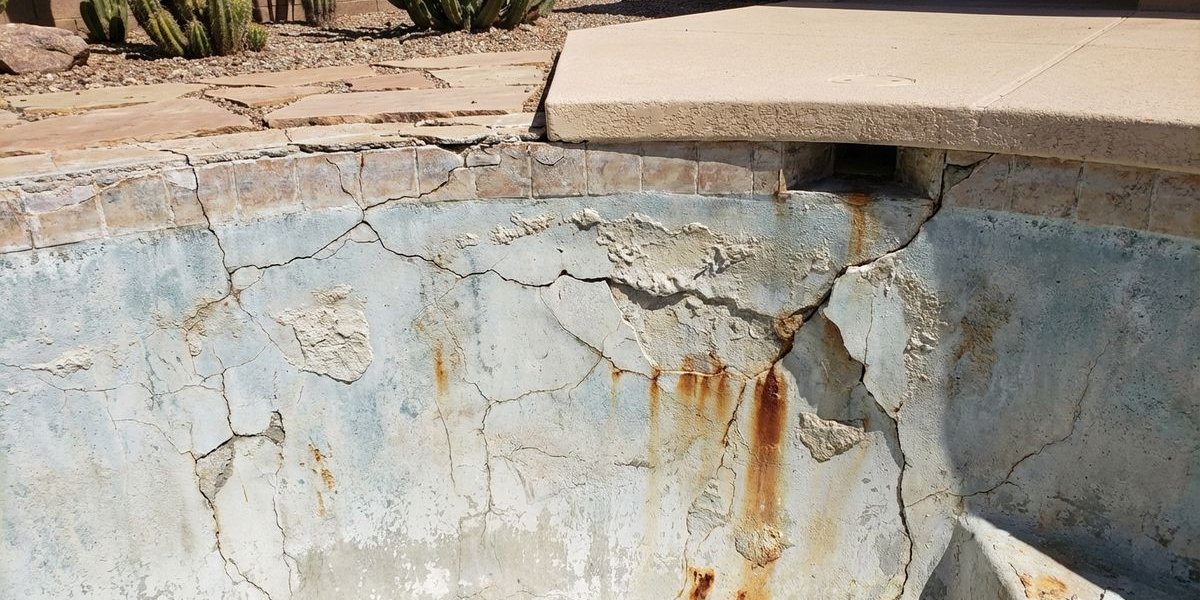
3. Visible Cracks and Spalling
Cracks in your pool surface range from cosmetic nuisances to serious structural concerns. We advise homeowners to look closely at the width and depth of any fissure they find.
Hairline vs. Structural Cracks
Small, surface-level cracks are common in older pools and are often just “check cracks” or crazing. They don’t necessarily mean immediate action is needed, but they should be monitored to ensure they don’t widen. A good rule of thumb is the “credit card test.” If you can slide the edge of a credit card into the crack, it is wider than 1/8 inch and requires professional attention.
Spalling (Surface Flaking)
When chunks of the surface are coming off, you’re past the minor repair stage. Spalling exposes the gunite shell to water and chemicals, accelerating damage. This often happens when the bond between the plaster and the shell fails, sometimes called “delamination.”
The Danger of Summer Draining
We strongly warn against draining your pool in the middle of a Phoenix summer to fix these cracks yourself. The surface temperature of an empty pool can soar rapidly, causing the shell to crack or pop out of the ground due to thermal shock. Draining is a task best left for the cooler months of November through March.
Why It Matters
- Water loss: Cracks can leak, wasting water and chemicals.
- Structural damage: Water infiltration damages the pool shell.
- Safety hazard: Sharp edges can cut swimmers.
- Property damage: Leaks can undermine surrounding structures.
Action Level
Hairline cracks: monitor. Spreading cracks or spalling: address within months.
4. Difficulty Maintaining Water Chemistry
If you’re suddenly adding more chemicals, fighting constant imbalances, or dealing with recurring algae despite treatment, your surface may be the problem.
The Hard Water Reality
Phoenix tap water is notoriously hard, often testing at 200 to 400+ ppm (parts per million) of Calcium Hardness right out of the hose. Since an uncovered pool here loses about 4 to 6 feet of water per year to evaporation, pure water leaves while the calcium stays and concentrates. As these minerals build up, they deposit on the surface, creating a rough scale that eats up your chlorine and chemicals.
The Cyanuric Acid Trap
We also see many pools suffering from “chlorine lock” due to high Cyanuric Acid (CYA) levels. While CYA acts as a sunscreen for your chlorine, levels over 100 ppm render your sanitizer ineffective. Old, porous plaster absorbs these imbalances, making it impossible to maintain a safe swimming environment without a total water change and resurface.
The Test
If you’ve ruled out equipment issues and your pool service confirms your chemistry routine is correct, the surface is likely contributing to problems.
Why It Matters
- Higher chemical costs: Throwing money at a symptom.
- Health concerns: Improper chemistry creates health risks.
- Frustration: Constant battle with no winning solution.
Action Level
Moderate urgency - problems will only worsen over time.
5. Your Pool Is Past Its Expected Lifespan
Sometimes the clearest sign is simply age. We find that the intense UV exposure in Arizona shortens the life of pool finishes compared to other parts of the country.
Expected Lifespans & 2025 Cost Estimates
The following table breaks down what you can expect in our region.
| Material | Est. Lifespan (AZ) | Relative Cost | Durability |
|---|---|---|---|
| Standard Plaster | 7-10 years | $ (Low) | Lowest |
| Quartz Aggregate | 12-15 years | $$ (Mid) | Good |
| Pebble Finishes | 15-20+ years | $$$ (High) | Best |
Why Age Matters
Even if you’re not seeing obvious problems, an aging surface has diminished chemical resistance. It is more susceptible to sudden failure and will show accelerating deterioration. Budgeting for this expense now prevents financial shock when the surface finally gives out.
Action Level
Get a professional assessment if approaching or past expected lifespan.
When Multiple Signs Appear
If you’re seeing two or more of these signs, action is needed. The combination of problems indicates systemic failure rather than isolated issues that can be patched.
The Cost of Waiting Too Long
Delaying resurfacing when it’s needed can lead to:
- More extensive prep work: Severely deteriorated surfaces require more work.
- Structural repairs: Damage that penetrates the shell is expensive to fix.
- Emergency situations: Complete failure forces rushed decisions.
- Higher overall costs: Addressing damage is more expensive than prevention.
Get a Professional Opinion
If you’re unsure whether your pool needs resurfacing, a professional assessment provides clarity. We examine the surface condition, identify specific issues, and give you honest recommendations.
Not every pool showing early signs needs immediate resurfacing. Sometimes repairs buy you more time. We’ll tell you the truth about your specific situation.
Call (602) 619-1234 for a free pool assessment.
David
Pool Resurfacing Expert at David Resurface