Cool Deck vs Regular Concrete: Which Is Better for Arizona Pools?
Compare Cool Deck heat-reflective coating to standard concrete. Temperature difference, durability, cost, and installation for Phoenix homeowners.
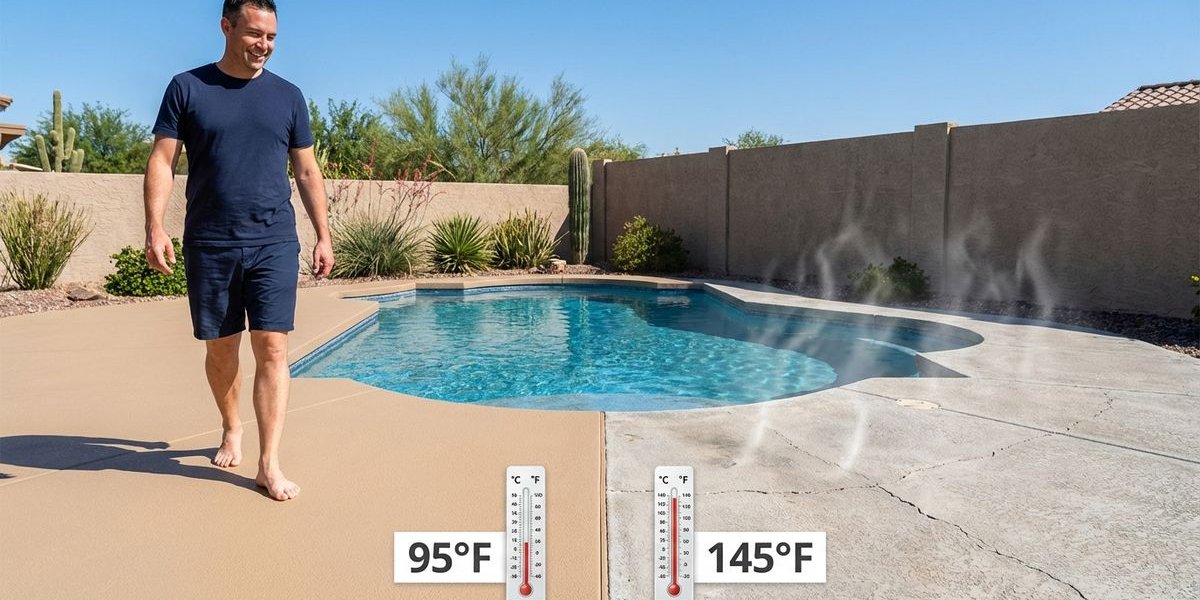
If you have ever done the “hot pavement dance” across a Phoenix pool deck in July, you know exactly why this topic matters.
From what we have seen in our field tests, regular gray concrete can easily hit 150°F on a typical summer afternoon here.
That is not just uncomfortable; it is dangerous for kids and pets.
We are going to break down the real data on temperature differences, the updated 2026 pricing for local installations, and the specific maintenance tricks that keep these surfaces lasting past the ten-year mark.
Let’s look at the numbers and help you decide if the investment makes sense for your backyard.
The Temperature Difference
You need to know if the cooling effect is actually real or just marketing hype.
Regular Concrete Performance
Standard gray concrete is a heat magnet because it is dense and retains thermal energy long after the sun goes down.
- Surface Heat: We consistently measure temps between 140°F and 160°F in direct sunlight.
- Heat Retention: It stays hot well into the evening, radiating heat back at you during night swims.
- Burn Risk: Skin can sustain burns in seconds at these temperatures.
Cool Deck Performance
Cool Deck (and similar acrylic lace coatings) works by changing the surface physics.
- Real-World Drop: Expect a surface temperature of 100°F to 110°F on that same scorching day.
- The “Walkability” Test: While 105°F sounds hot, it is below the pain threshold for most human skin, making it walkable barefoot.
- Rapid Cooling: The textured surface releases heat almost instantly when a cloud passes or the sun sets.
We have found that this 30-40 degree difference is the single biggest reason Phoenix homeowners choose to upgrade. Learn more about our cool deck resurfacing services for your pool area.
How Cool Deck Works
It is not magic; it is simply better engineering designed for our specific desert environment.
Solar Reflectance Index (SRI): The lighter pigments in these coatings are chemically formulated to reflect a higher percentage of the sun’s infrared spectrum.
The “Air Pocket” Texture: The classic “lace” or “orange peel” texture does more than look good. It creates tiny peaks and valleys that trap cooler air and prevent your foot from making full contact with the hot surface.
Thermal Emittance: Cement-based acrylics are designed to release absorbed heat quickly rather than storing it like dense stone or pavers.
Cost Comparison
Pricing has shifted in 2026, so here is what you can expect to pay for professional installation in the Valley.
| Surface Option | Cost per Sq Ft | Typical 500 Sq Ft Deck |
|---|---|---|
| Acrylic Cool Deck | $4 - $8 | $2,000 - $4,000 |
| Stamped Concrete | $12 - $18 | $6,000 - $9,000 |
| Travertine Pavers | $15 - $30 | $7,500 - $15,000 |
| Basic Concrete Pour | $8 - $12 | $4,000 - $6,000 |
We always remind clients to factor in the “hidden” costs of demolition if you are removing an old deck. Cool Deck is often the most budget-friendly because it can go directly over your existing concrete if the slab is stable.
Durability and Maintenance
Cool Deck Lifespan
You can expect a professional application to last 10 to 15 years, but this depends entirely on how you treat it.
- The “Sacrificial” Sealer: The clear coat on top takes the beating from the UV rays so the color doesn’t have to.
- Resealing Schedule: In Arizona, you must reseal every 2 to 3 years to prevent the color coat from chalking.
- Common Failure: Delamination (peeling) usually happens because water got underneath the coating through an unsealed crack.
Regular Concrete Lifespan
Plain concrete is structurally durable but aesthetically weak.
- Cracking: It is guaranteed to crack eventually due to our soil movement.
- Staining: Without a sealer, it absorbs oils from suntan lotion and BBQ grease permanently.
- Roughness: The surface gets pitted and rougher over time, becoming abrasive to bare feet.
Comfort and Safety
Slip Resistance Standards
Safety is about more than just temperature; it is about grip when the surface is soaking wet.
We look for coatings that meet the ANSI A326.3 standard, which requires a dynamic coefficient of friction (DCOF) of at least 0.55 for outdoor wet areas.
Cool Deck’s textured “knock-down” finish naturally exceeds this standard, creating a mechanical grip that prevents slips.
Smooth concrete or slick tiles can be incredibly dangerous the moment a cannonball splashes water onto the deck.
Barefoot Comfort
Texture plays a huge role in how the surface feels. Regular concrete acts like sandpaper on wet skin after a while. The acrylic polymers in Cool Deck smooth out the rough edges of the sand aggregates, making it softer to walk on despite the texture.
Aesthetic Options
Modern Color Trends
The days of “Harvest Gold” being the only option are gone.
- Greige & French Gray: These cool-toned neutrals are the top sellers in 2026 for a modern look.
- Sand & Beige: Still popular for their ability to hide dust between cleanings.
- White: The absolute coolest option temperature-wise, but it requires sunglasses to look at due to glare.
We caution against dark colors like “Charcoal” or “Terracotta” because they will absorb heat and negate the cooling benefits.
Decorative Finishes
You don’t have to stick to the standard lace pattern.
- Flagstone Pattern: We can tape off “grout lines” to mimic the look of expensive stone.
- Brick Borders: Using a contrasting color on the coping (the edge near the water) frames the pool beautifully.
- Custom Logos: Some homeowners are adding monograms or designs into the deck itself.
Installation Considerations
Over Existing Concrete
The prep work is actually more important than the painting.
- Acid Wash & Grind: The concrete pores must be opened up to accept the bonding agent.
- Crack Repair: We treat every crack with a flexible epoxy or elastomeric filler before coating.
- Cool Morning Application: In Phoenix, the coating must be applied early in the day (often starting at 5 AM) to prevent the chemicals from “flashing” or drying too fast in the heat.
New Construction
If you are pouring a brand new deck, the finish needs to be right from day one. We recommend a “hard trowel” finish rather than a broom finish if you plan to add Cool Deck later. This ensures a smoother base that requires less material to cover, saving you money on the coating.
Climate Considerations for Arizona
Summer Heat
This is the main event. Cool Deck allows you to actually use your pool area in July and August without wearing sandals.
Monsoon Season
Dust storms are the enemy of any deck coating. We advise pressure washing your deck immediately after a haboob (dust storm). If that dust sits and gets wet, it turns to mud that can stain the pores of the texture over time.
UV Exposure
The Arizona sun acts like a laser beam on exterior surfaces. Standard paints break down and chalk within a year. High-quality acrylic coatings use UV-stable pigments that resist fading for over a decade.
Making Your Decision
Choose Cool Deck if:
- You want a surface that is 30+ degrees cooler than concrete.
- Your budget is under $10 per square foot.
- You have an existing concrete deck that looks worn but is structurally sound.
- Slip resistance for kids or elderly family members is a priority.
Stick with Bare Concrete if:
- You are planning to cover the entire area with pavers or stone soon.
- The pool is in 100% shade all day (rare in Phoenix!).
- You are flipping the house and need the absolute zero-cost option.
- The concrete is severely heaved or broken and needs total replacement anyway.
Our Recommendation
For most Phoenix homeowners, Cool Deck is the “sweet spot” between performance and price.
It solves the heat problem effectively without the massive expense of installing travertine pavers.
We believe that if you can walk comfortably to your pool, you will use it twice as often.
Call (602) 619-1234 to discuss deck coating options for your pool.
David
Pool Resurfacing Expert at David Resurface