Pool Care Tips for Arizona Summers: Surviving 110°F Heat
Special pool maintenance considerations for extreme Arizona heat. Water evaporation, chemical balance, equipment protection, and more.
Pool Care Tips for Arizona Summers: Surviving 110°F Heat
Arizona summers present unique challenges for pool owners. With temperatures regularly exceeding 110°F, your pool requires special attention to stay clean, safe, and properly maintained.
Managing Evaporation
The Reality of Water Loss
Phoenix pools lose a staggering amount of water during peak summer months. We have measured evaporation rates reaching nearly half an inch per day in June and July. That adds up to roughly 50 to 60 inches of water loss per year for the average backyard pool. This constant loss changes your water chemistry as minerals stay behind while pure water leaves.
Practical Solutions
- Perform the Bucket Test: Determine if you have a leak or just high evaporation. Fill a 5-gallon bucket with water, place it on a pool step, and mark the water level inside the bucket and on the outside (pool water level). After 24 hours, compare the loss. If the pool drops more than the bucket, you likely have a leak.
- Consider Liquid Solar Covers: Bubble covers are effective but cumbersome in daily heat. Products like Cover Free create an invisible monolayer on the surface that reduces evaporation by up to 85% without the hassle of a physical blanket.
- Monitor Your Auto-Fill: A stuck auto-fill valve can hide a leak for months. Check the float valve inside the canister (usually in the deck) weekly to ensure it shuts off completely.
Chemical Challenges in Extreme Heat
The Cyanuric Acid Trap
High heat destroys liquid chlorine rapidly, often within hours. We frequently see homeowners compensating by adding more Trichlor tablets to their floating dispensers. This creates a dangerous cycle known as “chlorine lock.” These tablets contain Cyanuric Acid (CYA), and once your CYA levels exceed 100 ppm, your chlorine becomes ineffective regardless of how much you add.
Solutions:
- Switch to Liquid Chlorine: During the hottest months (June-August), use liquid sodium hypochlorite or Cal-Hypo powder for shocking. These sanitizers add chlorine without raising your CYA levels.
- Test with Precision: Ditch the test strips, which can fade and give inaccurate readings in the intense sun. We rely on the Taylor K-2006 test kit for its accuracy with drop-count titrations, especially for measuring CYA and Free Chlorine levels.
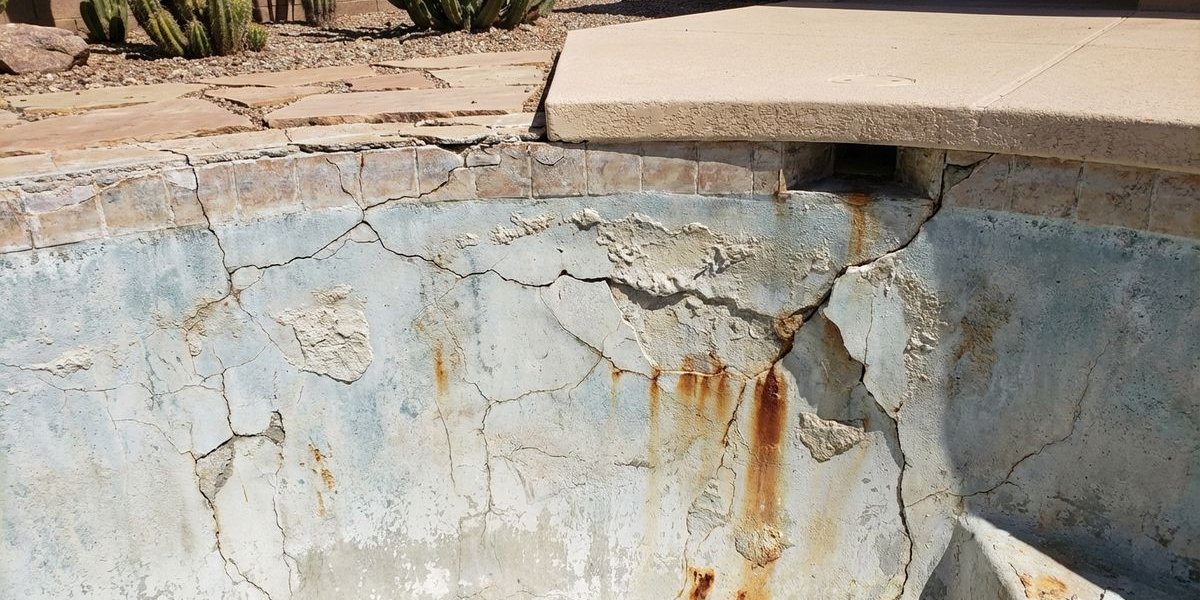
- Protect Your Plaster: High water temperatures (90°F+) combined with poor chemistry can cause calcium scaling or etching on older plaster. Test your Langelier Saturation Index (LSI) to keep water neutral. If your surface is damaged beyond repair, consider pool resurfacing to restore it.
pH Drift and Management
Arizona’s hard water and high evaporation concentrate minerals that naturally push your pH up.
- Test pH Twice Weekly: Keep it between 7.4 and 7.6.
- Use Muriatic Acid: Add acid in small doses (e.g., one pint at a time) with the pump running to prevent damage to the pool floor.
- Watch Alkalinity: High alkalinity acts as an anchor for high pH. Keep Total Alkalinity (TA) between 80-120 ppm to make pH management easier.
Algae Prevention
The Mustard Algae Threat
Green algae is common, but Arizona pools are particularly prone to yellow “Mustard Algae” which looks like dirt or pollen on the floor. It is resistant to normal chlorine levels and loves the shady side of the pool.
Strategic Prevention
- Brushing is Mandatory: Algae forms a protective biofilm that chemicals cannot penetrate easily. You must brush the walls and floor weekly with a steel-bristle brush (for plaster) or nylon (for pebble/vinyl) to break this seal.
- Circulate During the Day: Stagnant water in 110°F heat is an incubator for bacteria. Ensure your pump runs during the hottest part of the day (12 PM - 4 PM) to keep water moving.
- Use Specific Algaecides: For Mustard Algae, use sodium bromide-based products like “Yellow Out” in conjunction with chlorine shock.
Comparison of Algae Treatments
| Treatment Type | Best For | Pros | Cons |
|---|---|---|---|
| Liquid Chlorine | Routine Maintenance | No residue, fast-acting | degrades quickly in UV |
| Polyquat 60 | Prevention | Long-lasting, non-foaming | Expensive, weak against blooms |
| Copper Algaecide | Black Algae | Effective on roots | Can stain old plaster blue/green |
| Sodium Bromide | Mustard Algae | Kills resistant strains | Consumes massive amounts of chlorine |
Pump and Equipment Care
Optimizing Energy Costs
Electricity rates from APS and SRP spike during peak demand hours. We advise our clients to check their specific “Time-of-Use” plan, which typically has on-peak hours between 4 PM and 7 PM (or 2 PM to 8 PM depending on the plan).
- Variable Speed Pump (VSP) Strategy: Run your VSP at a low speed (1500-2000 RPM) for 10-12 hours a day. This moves more water for less money than running a single-speed pump for 4 hours.
- Schedule Around Peaks: Set your timer to run the filtration cycle from 4 AM to 1 PM, avoiding the expensive late afternoon rates entirely.
Equipment Survival
- Ventilation is Key: Pump motors are air-cooled. Clear away overgrown oleanders or bougainvillea that block airflow around your equipment pad.
- Protect the Screen: The LCD screens on modern pumps and salt cells will turn black and fail in direct sunlight. Glue a simple plastic flap or cover over the screen to extend its life.
Deck and Surface Preservation
The Dangers of Summer Draining
Never fully drain an old plaster pool when the air temperature is above 85°F. We have seen older plaster surfaces dry out, shrink, and “pop off” (delaminate) from the concrete shell within hours of being drained in the summer heat. The thermal shock can be catastrophic for pools aged 10-15 years.
Safe Alternatives:
- Partial Drain: If your CYA or Calcium levels are too high, drain only 1-2 feet of water in the evening and refill immediately. Repeat this process over several nights.
- Wait for October: Unless it is an emergency, postpone any acid washes or full drains until temperatures drop below 85°F consistently.
Deck Maintenance
- Seal Your Cool Deck: Acrylic “Cool Deck” toppings are porous. Re-seal them every 2-3 years to prevent the concrete from absorbing water and cracking during thermal expansion.
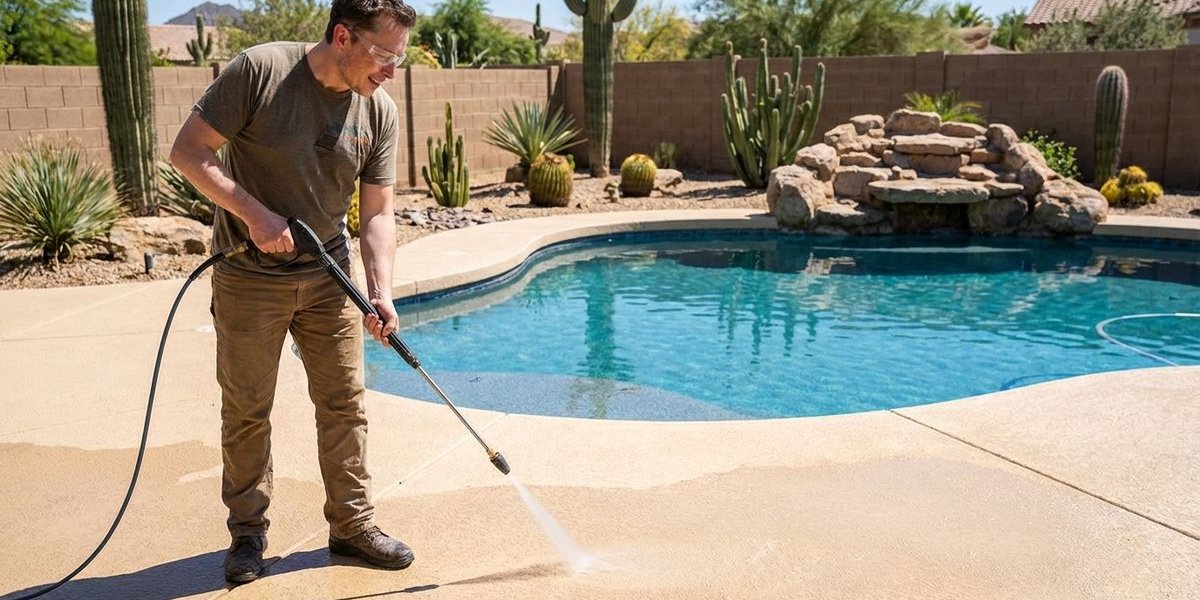
- Clean with Care: Use a mild detergent and a garden hose. Avoid high-pressure power washing on aged deck paint, as it can strip the texture.
Safety in Extreme Heat
Managing Water Temperature
Pool water in Phoenix can naturally reach 90-95°F in August. Warm water promotes rapid bacterial growth.
- Aeration: Run a portable fountain or your pool’s aerator (if equipped) at night. Evaporative cooling can drop water temperature by 5-10 degrees.
- Chlorine Demand: Bacteria reproduce twice as fast in 90°F water as they do in 80°F water. Check chlorine levels three times a week during heatwaves.
Barrier Safety
Heat dries out the soil, causing gates and fences to shift. We recommend checking your gate latch monthly. Ensure it self-closes and self-latches from any open position, as required by Arizona pool barrier codes. A MagnaLatch system can be adjusted if the gate alignment shifts due to soil movement.
Monsoon Season Protocols
The Phosphate Connection
Dust storms (Haboobs) dump tons of dirt and organic matter into your pool. This dust is loaded with phosphates, which are the primary food source for algae.
Post-Storm Action Plan
- Skim Immediately: Remove debris before it sinks and stains the plaster.
- Test Phosphates: Use a phosphate test kit after a major storm. If levels are over 500 ppb, use a phosphate remover (like Orenda PR-10,000) to starve potential algae.
- Clean the Filter: All that dust ends up in your filter. Backwash sand/DE filters or clean cartridge elements immediately after the water clears to reduce pump pressure.
Weekly Summer Checklist
- Test Chlorine & pH (Monday, Wednesday, Friday)
- Empty Skimmer Baskets (Daily - heavily shedding mesquite/palo verde trees can clog skimmers in hours)
- Brush Walls & Steps (Weekly - focus on corners and steps)
- Check Water Level (Verify auto-fill is functioning)
- Listen to the Pump (Grinding noises indicate overheating bearings)
- Inspect Gate Latches (Verify self-closing mechanism works)
- Add Chlorine (If using liquid, add at dusk to prevent UV burn-off)
Following this routine keeps your pool swimmable and protects your investment during Arizona’s extreme summer conditions.
Questions about summer pool care? Call (602) 619-1234 for expert advice.
David
Pool Resurfacing Expert at David Resurface